
AI & DEVELOPMENT
AI Coding Agents Can Write the Code. Now What?
AI coding agents are moving software development from autocomplete to autonomy. They can inspect repositories, modify files, run tests, and complete real engineering tasks. But the bigger question is whether developers are ready to trust them.
AI coding agents can write the code. Now what?
Software development is moving from autocomplete to autonomy. The interesting question is no longer whether AI can generate code. It is whether we are ready to trust it with real engineering work.
For years, AI helped developers type faster. Coding agents are different. They do not just suggest the next line. They inspect repositories, modify files, run tests, fix errors, and increasingly complete entire tasks.
The shift is bigger than autocomplete.
Traditional coding assistants live inside the editor. You type, they predict. You decide, they assist.
Coding agents flip that relationship. You describe an outcome, give them access to a codebase, and allow them to work through the implementation themselves.
Old workflow
Developer writes code → AI suggests snippets → developer integrates → developer tests.
Agent workflow
Developer defines task → agent investigates → agent changes code → agent tests → developer reviews.
What makes agents genuinely different?
They read the system.
Modern agents can inspect multiple files, understand project structure, follow dependencies, and reason across a larger codebase.
They take actions.
They can edit files, run commands, execute tests, inspect logs, and iterate after failures.
They correct themselves.
A failed test no longer necessarily ends the AI interaction. An agent can inspect the failure and attempt another fix.
They complete tasks.
The unit of interaction is becoming less about “write this function” and more about “solve this engineering task.”
Then comes the uncomfortable part: trust.
An agent producing a working result is not the same as an agent producing a result you should ship.
Generated code can be elegant and wrong at the same time. It can pass the obvious test while missing a security edge case. It can introduce unnecessary dependencies. It can misunderstand a business rule that was never written down.
This is why experienced engineers still matter. Architecture, production trade-offs, debugging intuition, security thinking, data modelling, observability, and understanding users are much harder to reduce to a prompt.
The best developers may write less code.
That sentence sounds threatening until you compare it with every previous abstraction in software engineering.
Assembly developers wrote less machine code. High-level languages reduced boilerplate. Frameworks removed repetitive infrastructure. Cloud platforms eliminated piles of server administration.
Coding agents are another abstraction layer — except this time the abstraction sits directly between human intent and implementation.
The high-value engineer
Understands the problem, decomposes it well, designs reliable systems, gives agents strong constraints, reviews critically, and takes responsibility for the final outcome.
So are AI coding agents replacing developers?
Some development work will absolutely disappear. Repetitive CRUD, boilerplate, basic migrations, test generation, documentation, refactoring, and straightforward UI work are increasingly easy to delegate.
But software engineering has never really been about typing code. The code is the final representation of hundreds of decisions.
Agents are becoming very good at producing that representation. Humans are still responsible for making sure the decisions behind it are good ones.
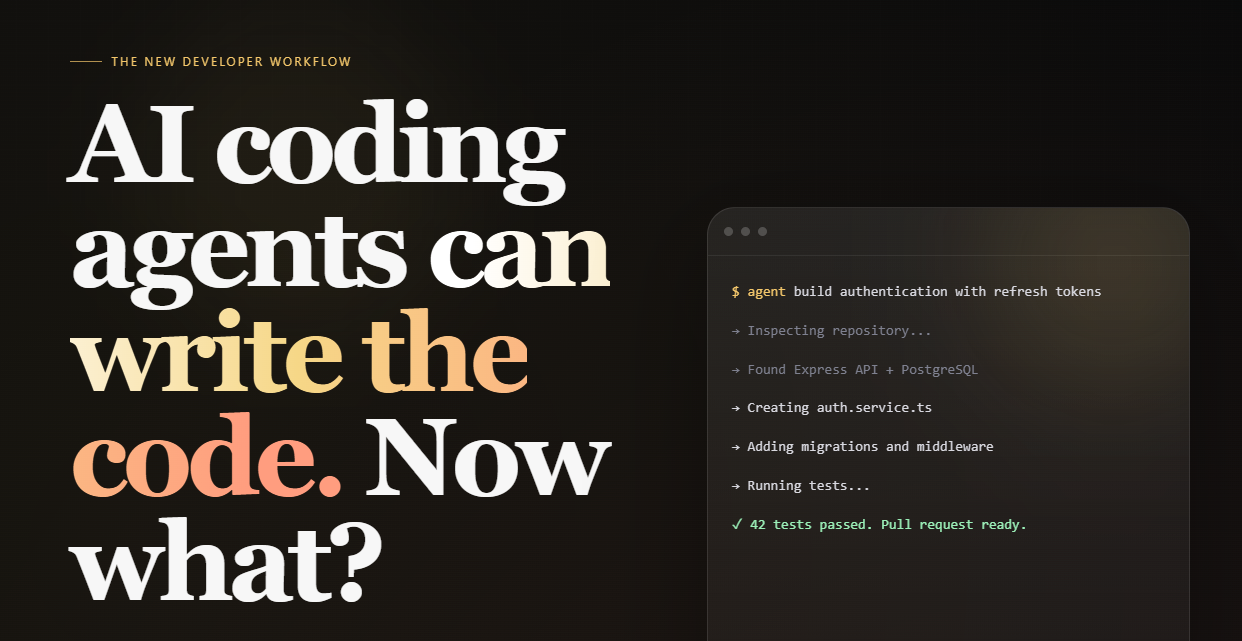
AI coding agents are moving software development from autocomplete to autonomy. They can inspect repositories, modify files, run tests, and complete real engineering tasks. But the bigger question is whether developers are ready to trust them.
Article visuals are generated or attached through the site image pipeline and rendered only when image assets are available for this post.
This article currently has no attached generated hero image.